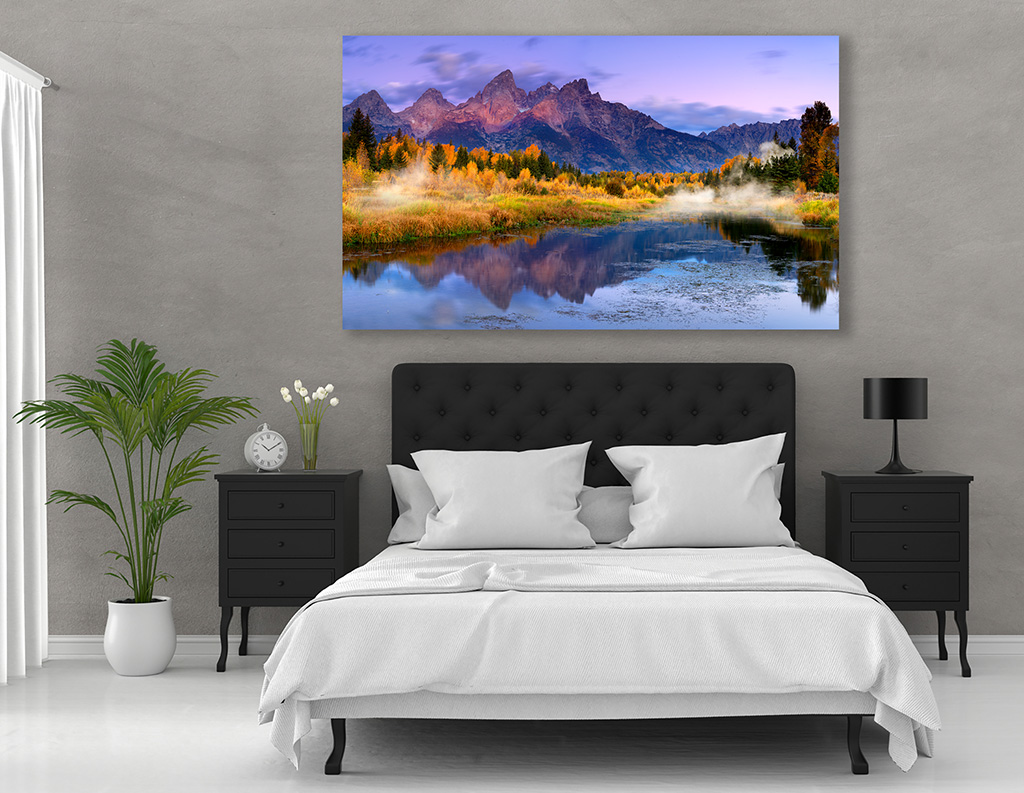
There are certain mornings in the wilderness that stay with you long after you’ve packed up your camera and left.
Convergence was born on one of those mornings. I found myself sitting along the icy shores of the Snake River in Grand Teton National Park, waiting for the first light of day. The air was cold and still, and a thin mist hovered above the water. Somewhere in the distance, elk were beginning to bugle, their calls carrying across the valley in the darkness.
Then the mountains began to catch the first light. A soft purple glow moved across the Teton Range while the autumn landscape below slowly came alive in brilliant shades of gold. The rising mist drifted through the grasses and along the river, while the perfectly still water reflected the mountains and the changing sky.
For a brief moment, everything seemed to come together—the light, the water, the mist, the autumn colors, the mountains, and the wildlife.
That is where the name Convergence came from.
It felt as though nature had brought every element together for one fleeting moment, creating something far greater than any one of them could have created alone.
A Landscape Worth Protecting
Grand Teton is a place with a remarkable history of its own.
Long before it became a national park, Indigenous peoples traveled through and lived within Jackson Hole, following seasonal cycles of hunting, fishing, and gathering. Later came explorers, fur trappers, homesteaders, and ranchers. John Colter, who had been part of the Lewis and Clark expedition, is believed to have traveled through the region during the winter of 1807–1808.
The effort to protect this landscape took decades.
Congress established the original Grand Teton National Park in 1929, but that park was considerably smaller than the one we know today. It primarily protected the dramatic peaks of the Teton Range and several lakes at their base.
The valley remained a complicated patchwork of private lands, ranches, and federal property. In 1943, President Franklin D. Roosevelt established Jackson Hole National Monument, protecting much of the valley floor. At the same time, John D. Rockefeller Jr. had quietly been purchasing thousands of acres through the Snake River Land Company with the intention of eventually donating the land for conservation. He ultimately donated approximately 35,000 acres to the federal government.
In 1950, Congress combined the original national park, Jackson Hole National Monument, and the Rockefeller lands to create the Grand Teton National Park we know today—more than 310,000 acres of mountains, rivers, forests, lakes, and wildlife habitat.
Standing beside the Snake River at sunrise, it’s easy to forget how much effort went into making sure places like this would still exist for us to experience.
The Snake River itself has also become part of the visual history of the Tetons. In 1942, Ansel Adams made his now-famous photograph of the Teton Range from along the Snake River. At that time, however, the river and much of the valley in his composition were not yet within the boundaries of Grand Teton National Park. Those lands became part of the park through the 1950 expansion.
More than eight decades later, I found myself standing along that same river, camera in hand, experiencing my own quiet moment with this incredible landscape.
And that is one of the things I love most about photographing America’s National Parks. The landscape doesn’t belong to any one person. It belongs to all of us—and, more importantly, to the generations who will come after us.
Convergence is my attempt to preserve one small moment in that much larger story: a cold autumn morning, the sound of elk echoing through Jackson Hole, mist rising from the Snake River, and the first light touching the Tetons.
A moment when everything came together. And one I will never forget.