
Mono Lake
There are places in the Eastern Sierra that seem almost timeless. Mono Lake is one of them. Its vast expanse of water, volcanic islands, distant Sierra peaks, and unusual shoreline create a landscape that feels almost otherworldly.
But when I began looking more closely at Mono Lake, I became just as interested in what is missing from the landscape as what remains.
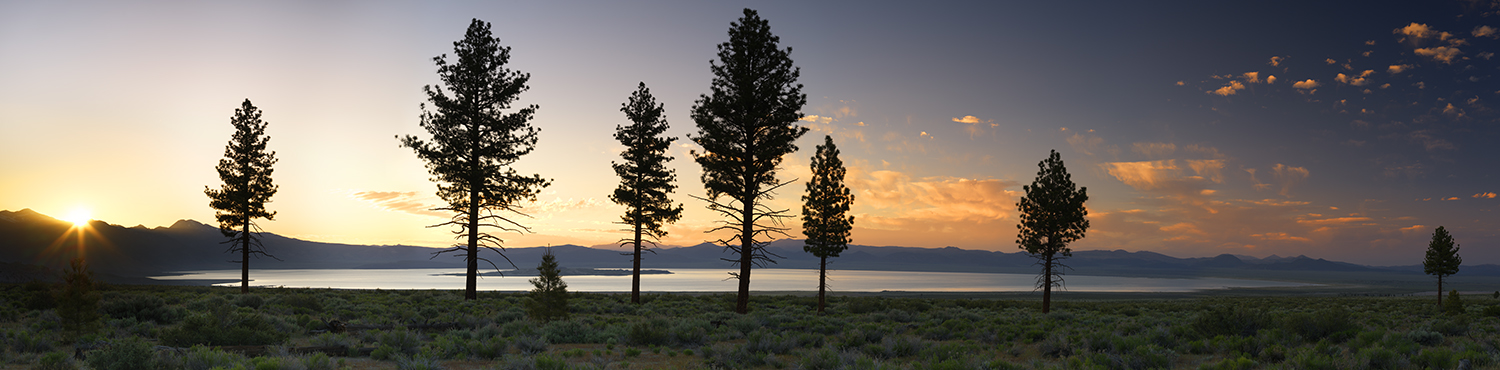
Mono Lake is my newest fine art release, and this photograph is about those remnants—the last few trees that still stand along the lake’s edge.
The image was made at sunset, when the final light of the day was falling across the lake. The Sierra Nevada were becoming silhouettes, the sky was filled with warm evening color, and the remaining trees stood between the sagebrush-covered foreground and the enormous expanse of water.
Rather than making the lake itself the sole subject, I wanted to use these trees as the focal point. Their silhouettes create a quiet rhythm across the photograph, while the open landscape behind them gives a sense of just how vast Mono Lake really is.
A landscape shaped by gold
Today, it is easy to look across the Mono Basin and assume that the open, almost barren landscape has always looked this way. It hasn’t.
During the height of the mining boom in the late 1800s, the Mono Basin became an important source of timber and fuel for the nearby mining communities, particularly the booming gold-mining town of Bodie. Timber was harvested throughout the basin and transported toward the mines. A narrow-gauge railroad was eventually constructed along the eastern side of Mono Lake to move lumber toward Bodie.
Historical records describe woodland corridors extending through much of the Mono Basin, with montane conifer forests reaching to within roughly a quarter mile of the lake.
The demand for lumber and fuel changed that landscape dramatically.
Bodie itself grew into one of the great boomtowns of the American West after gold was discovered there in 1859. At its peak, thousands of people lived in the town, creating an enormous demand for building materials and fuel in an otherwise harsh, high-desert environment.
Looking at Mono Lake today, it is difficult to imagine a time when significantly more trees surrounded this landscape.
That history is one of the reasons I was drawn to these remaining trees.
More than just a beautiful lake
Mono Lake is also one of the most unusual and ecologically important lakes in California.
It is a terminal lake, meaning it has no natural outlet. Water enters the lake primarily through streams flowing down from the Sierra Nevada, and because there is nowhere for the water to flow out, minerals accumulate over time. The result is a highly saline and alkaline lake that supports a remarkable ecosystem of brine shrimp and alkali flies, which in turn provide an important food source for millions of migratory and nesting birds.
But Mono Lake has also been at the center of one of California’s most important environmental battles.
Beginning in 1941, the Los Angeles Department of Water and Power diverted water from four major tributaries flowing into Mono Lake. Over the following decades, the lake dropped dramatically. By 1982, its surface elevation had fallen approximately 45 feet from its 1941 level, while its surface area had decreased substantially.
The declining lake level threatened the unique ecosystem and even exposed connections between islands and the mainland that allowed predators to reach nesting birds.
The fight to protect Mono Lake eventually became a landmark environmental case. The Mono Lake Committee was formed in 1978, and years of scientific research, public advocacy and legal battles eventually led to changes in how water could be diverted from the Mono Basin. In 1994, the California State Water Resources Control Board adopted Decision 1631, establishing protections intended to restore Mono Lake and its tributary streams.
The trees that remain
That history gives this photograph a little more meaning for me.
These aren’t simply trees standing beside a beautiful lake.
They are reminders of a landscape that has changed dramatically over generations.
The mountains, the lake and the sky can make Mono Lake feel eternal. But the trees tell a different story. They remind us that landscapes are constantly being shaped by the people who live in them, the resources they take from them, and eventually, the efforts made to protect them.
When I composed this photograph, I wanted to keep the image simple. The lake stretches almost endlessly across the frame, while the trees stand quietly in the foreground. The setting sun sits low on the horizon, illuminating the sky and creating a final burst of light before disappearing behind the Sierra.
There is something I really like about that contrast—the enormous scale of Mono Lake against these relatively small, solitary trees.
This photograph is not only about Mono Lake. It is about what remains.
It is about history, change and resilience, and about taking the time to notice the small details in a landscape that can otherwise seem impossibly vast.
Mono Lake is now available as a new fine art release.
